
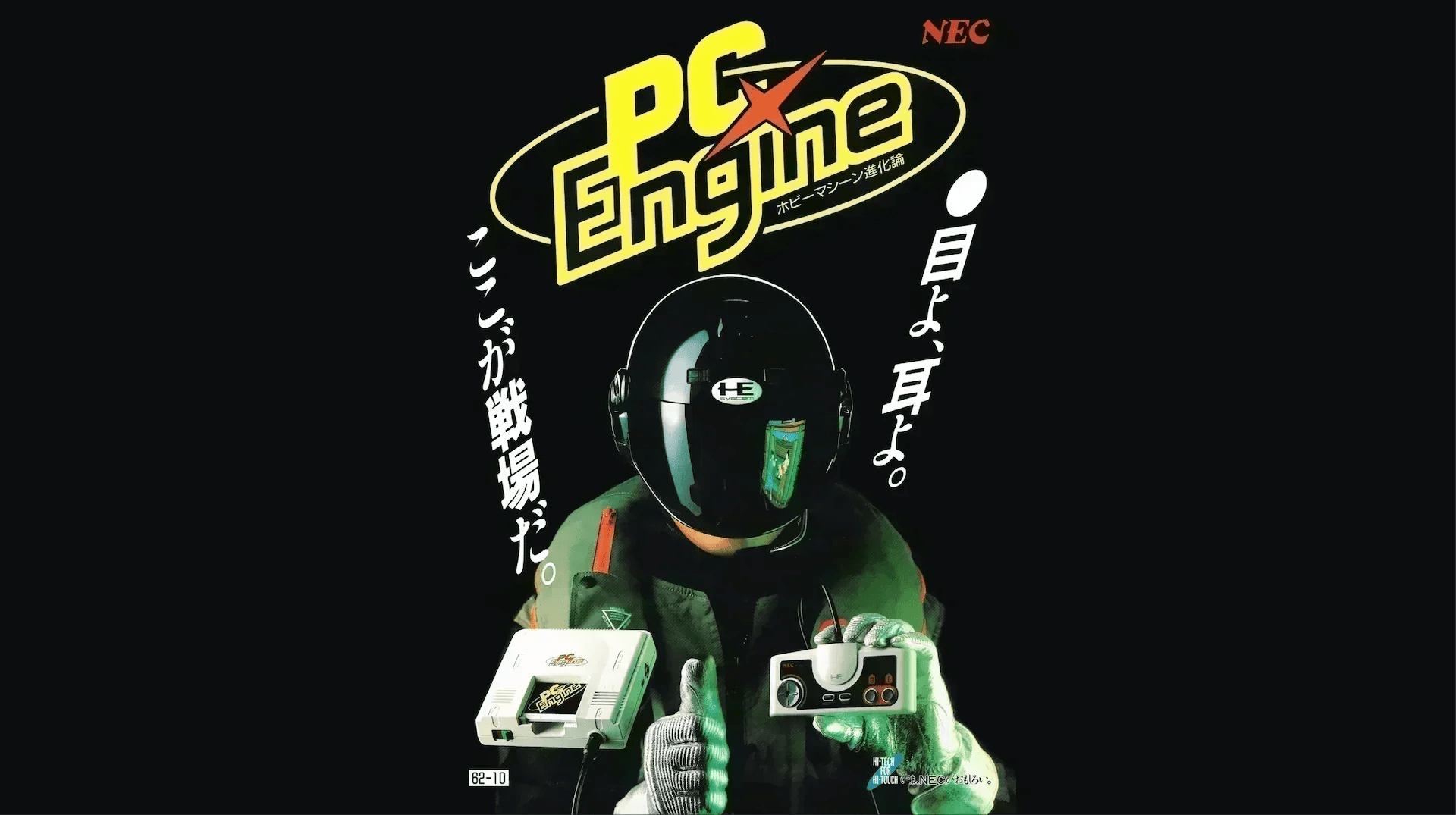
A console that redefined competition

In the late 1980s, NEC’s PC Engine (released as the TurboGrafx-16 overseas) carved out a unique space in gaming history. Launched in Japan in 1987, it was co-developed with Hudson Soft, a partnership that paired NEC’s hardware expertise with Hudson’s inventive software library. The result was a console that, while technically an 8-bit machine, had a custom 16-bit graphics chip that allowed it to display visuals far beyond what Nintendo’s Famicom or Sega’s Master System could manage at the time.
Its futuristic look — small enough to fit in a jacket pocket — contrasted sharply with the bulkier consoles of the era. The PC Engine quickly gained a reputation for style, speed, and arcade-perfect game experiences. Though it never achieved Nintendo or Sega’s global dominance, its daring design and creative library made it one of the most beloved retro video game consoles. For collectors, the PC Engine embodies the spirit of innovation that defined Japan’s golden age of console development.
Japanese success, Western struggle
In Japan, the PC Engine was an immediate hit. It captured the public’s imagination with ports of arcade titles like R-Type, Gradius, and Splatterhouse. Hudson Soft’s own mascot, Bonk, became a star through Bonk’s Adventure, cementing the system’s identity as something fresh and distinctly Japanese. By the early 1990s, the PC Engine had built a massive game library and even outsold Sega’s Mega Drive for stretches, second only to Nintendo’s Super Famicom.
Outside Japan, however, the story was very different. The TurboGrafx-16 launched in North America in 1989 but struggled from the start. NEC made the console larger, marketed it awkwardly, and failed to secure the same breadth of third-party support as in Japan. The rise of the Sega Genesis and later the Super Nintendo left little room for the TurboGrafx, and many of its best games — from RPGs to shoot-’em-ups — never made the jump overseas. This contrast — huge Japanese success paired with limited Western reach — makes the system especially fascinating for fans of retro video game consoles today.
Collectibility and rarity
The PC Engine and TurboGrafx’s legacy as a collector’s item comes not only from its games but also from the dizzying array of hardware models and accessories NEC released. Beyond the original white PC Engine, there was the CoreGrafx (with improved video output), CoreGrafx II, and the high-end SuperGrafx, which promised enhanced visuals but received only five exclusive games. Each iteration is now a unique collectible in its own right.
The portable PC Engine GT (known as the TurboExpress overseas) brought HuCards on the go, years before handheld consoles offered home-console-quality gaming. Limited production and fragile screens have made the GT one of the most expensive pieces in the ecosystem today. Accessories like the multitap, Tennokoe Bank (a save memory unit), and even quirky peripherals like the Avenue Pad controllers further expanded the ecosystem. Collectors prize complete-in-box sets with original manuals and packaging, with pristine mint condition consoles commanding high prices in today’s market.
Japan also saw exclusive variants, from special color shells to bundled sets tied to major releases. These rare consoles from Japan remain highly sought after, as they never left Japanese shelves and embody the system’s strong domestic identity.
The legacy of HuCards and CD-ROM²

One of the PC Engine’s most striking innovations was its HuCard format. Instead of bulky cartridges, games were stored on credit card–sized cards — slim, futuristic, and instantly iconic. These HuCards became collector favorites thanks to their striking cover art, often featuring vivid anime-inspired designs. For many enthusiasts, assembling a full HuCard library is as rewarding as collecting the consoles themselves.
In 1988, NEC pushed boundaries again with the CD-ROM² add-on, the world’s first CD-based expansion for a home console. This opened the door to larger games, CD-quality soundtracks, and animated cutscenes, setting the stage for the RPG boom of the 1990s. Classics like Ys Book I & II, Dracula X: Rondo of Blood, and Lords of Thunder showcased the CD-ROM²’s power, offering experiences competitors couldn’t match at the time. Later iterations like the Super CD-ROM² and Arcade Card expanded the capabilities further, ensuring the PC Engine remained cutting-edge throughout its lifespan.
For collectors, these add-ons — especially in boxed form — are prized not only for their rarity but for what they represent: milestones in the evolution of console technology. The PC Engine wasn’t just ahead of its time; it was paving the road others would later follow.
A thriving software library
 The system’s library is another reason collectors obsess over it. With nearly 700 titles released across HuCard and CD formats, the PC Engine is a treasure trove for fans of shoot-’em-ups, platformers, and role-playing games. Japan received the lion’s share of these releases, including cult classics and genre-defining titles that never reached Western players. This deep, Japan-centric catalog makes the hunt for authentic software a key part of the collecting experience.
Particularly valuable are first-print HuCards in sealed condition, promotional releases, and late-era CD titles with smaller production runs. Collectors who manage to build comprehensive sets often view them as the crown jewel of their retro libraries.
One of the most recognizable faces of the PC Engine era was PC Genjin (Bonk’s Adventure in the West). The caveman with a giant head became the unofficial mascot for NEC’s consoles, starring in platformers that showcased the system’s color palette and quirky charm. For many players, PC Genjin embodied the playful, offbeat personality of the PC Engine brand.
The lasting influence
Today, the PC Engine and TurboGrafx stand as more than relics — they are cultural icons that illustrate the creativity and experimentation of Japan’s console industry in the late 1980s and early 1990s. They embody the risks NEC and Hudson were willing to take, even in the face of giants like Nintendo and Sega.
For collectors, the system remains a blend of nostalgia and discovery. Every variant, every HuCard, every add-on tells a story about a company that dared to innovate. Owning one is about preserving not just hardware, but the pioneering spirit of an era.
Within RetroPixl’s retro video game consoles coverage, the PC Engine ranks alongside icons like the Super Famicom and Sega Saturn as a system that defined innovation. To explore another example of Japan’s influence, revisit our Super Famicom Legacy in Japan (Mar 2016), which shows how Japanese consoles set global trends.
Share:
Neo Geo Mini launch craze in Japan
Tokyo Game Show 2018 - Retro Highlights