
Nintendo was thinking in 3D long before the 3DS
Long before the Virtual Boy, and more than two decades before the Nintendo 3DS, Nintendo is already experimenting with stereoscopic gaming at home.
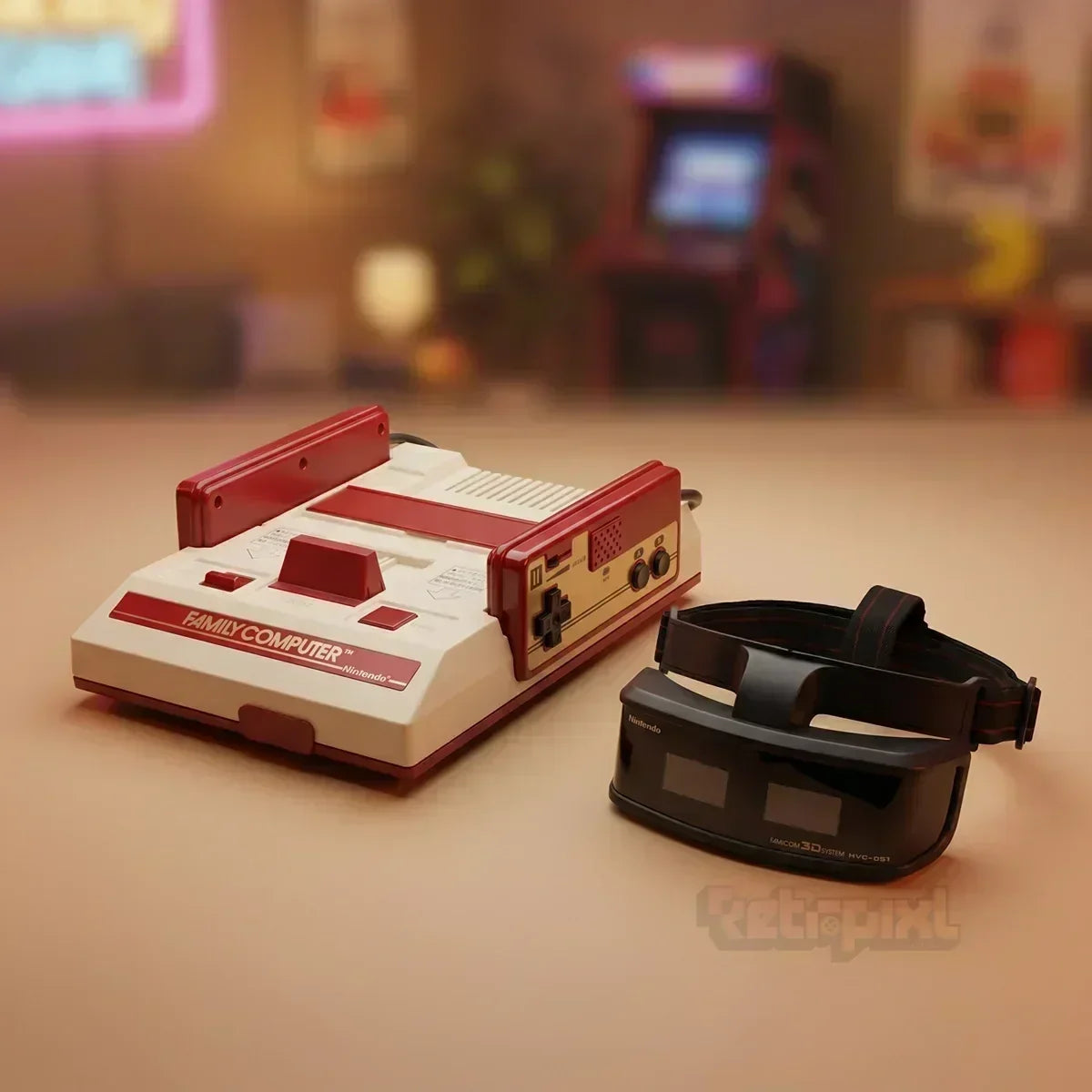
Released exclusively in Japan in 1987, the Famicom 3D System is a pair of electronic shutter glasses designed for the Famicom. It is one of those wonderfully unusual Nintendo experiments that feels surprisingly modern for something created during the 8-bit era.
We currently feature the Famicom 3D System at RetroPixl, and seeing the original glasses, adapter and packaging together makes it easy to understand why it stands out among Japanese gaming Accessories.
So how does 3D gaming work in 1987?

The glasses connect to the Famicom through a dedicated adapter attached to the console's expansion port. Their liquid-crystal shutters rapidly alternate between the left and right eyes while a compatible game displays corresponding images on a CRT television. Your brain combines those alternating views to create the impression of depth.
There is no headset, motion tracking or glasses-free display here. It is a very 1980s solution to an idea that gaming companies will continue chasing for decades.
Only a small selection of games supports the system. Among them are Falsion, Highway Star and Famicom Grand Prix II: 3D Hot Rally, with the latter becoming one of the best-known examples of Nintendo's early experiments with stereoscopic gaming.
3D Hot Rally also runs through the Famicom Disk System, meaning players need both the disk expansion and the 3D glasses to experience Nintendo's full setup. It is complicated, slightly excessive and exactly the kind of experimentation that makes this period of Japanese retro gaming so interesting.
An experiment that never becomes standard

The Famicom 3D System never becomes an essential part of the Famicom experience. It stays exclusive to Japan, works with only a limited number of titles and depends on CRT technology that is hardly convenient compared with simply loading a normal game.
But the idea itself does not disappear.
Nintendo returns to stereoscopic gaming with the Virtual Boy in 1995, taking a much more ambitious approach with an entire system built around depth and 3D imagery. That experiment also struggles commercially, but Nintendo keeps exploring the concept.
Eventually, the company arrives at the Nintendo 3DS in 2011, delivering stereoscopic 3D without requiring glasses at all.
Seen in that longer timeline, the Famicom 3D System becomes much more than a strange Famicom peripheral. It is an early chapter in Nintendo's decades-long fascination with making games extend beyond a flat screen.
That story adds another layer to the consoles in our Retro Gaming Collection, where unusual ideas often matter just as much as commercial success.
Why collectors still hunt for it

For collectors, the Family Computer 3D System combines several things that make Japanese Nintendo pieces fascinating: unusual technology, limited regional availability, distinctive packaging and a concept tied to a much bigger part of Nintendo history.
Finding the glasses alone is one thing. Finding the original system preserved with its adapter, documentation and box gives a much clearer picture of how Nintendo actually presented this futuristic accessory to Japanese players in 1987.
It also sits naturally alongside later experiments such as the Virtual Boy and Nintendo's many unusual handhelds. Together, they show a company willing to revisit an idea even when earlier attempts do not quite work.
Still seeing things differently

The Famicom 3D System never transforms the Famicom generation, but that is exactly why it remains so interesting today. It captures Nintendo testing an idea simply because it might make games feel different.
In 1987, that means shutter glasses, a CRT television and a handful of compatible games. Years later, the technology changes dramatically, but Nintendo's fascination with adding another dimension to play remains.
It also shows how early Nintendo was willing to experiment beyond the standard console experience. The idea may have been too limited to become mainstream, but it points toward the same curiosity that later produces the Virtual Boy and Nintendo 3DS. For collectors today, the unusual glasses and unmistakably 1980s presentation make it one of the Famicom era's most distinctive accessories. Complete examples also preserve a part of Nintendo history that many players outside Japan never encountered at all. Sometimes the experiments that do not succeed are the ones that become the most fascinating decades later.
For retro gaming collectors, the 3D glasses preserve one of the earliest and most unusual chapters of that story.
Share:
SEGA UNIVERSE POPUP STORE: classic Sega takes over Shibuya
Guide: Can Japanese retro consoles be used outside Japan?