
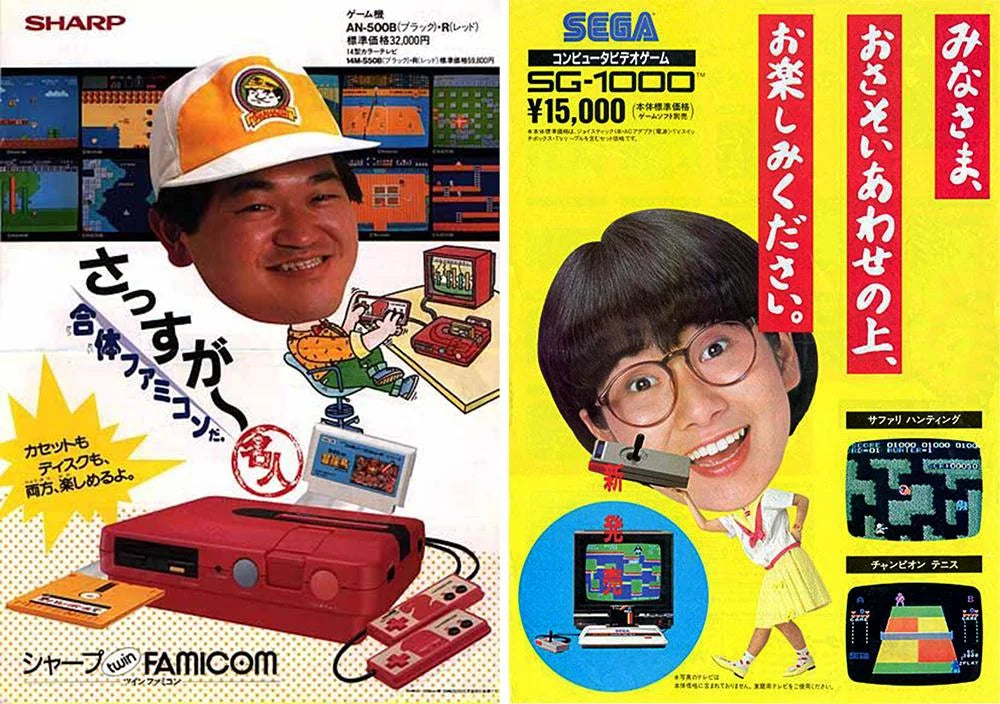
Yes, but where you live makes a difference
You find the Japanese console you have been looking for, the box is beautiful, the condition is right, and then comes the obvious question: will it actually work where you live?
In many cases, yes. Japanese retro consoles can be enjoyed around the world, but the setup is not identical everywhere. Power, plug type, video signal, region locking and language can all matter, and the answer for New York may be very different from the answer for Paris, Dubai, São Paulo or Singapore.
That is especially important with the Japanese consoles in our Retro Gaming Collection. Before plugging anything in, it helps to know what your system expects and what your local setup provides.
Power is the first thing to check

Japan uses 100V, with 50Hz in eastern Japan and 60Hz in western Japan. Once a Japanese console leaves the country, that becomes the first thing to check.
North America is relatively close. The United States and Canada use around 120V, while Mexico generally uses 127V. The familiar plug shape can make Japanese equipment look ready to use, but an original 100V power supply should still be checked before connecting it directly.
Europe is very different, with most countries using around 230V. A Japanese 100V-only power supply should never simply be plugged into a 230V outlet.
Across the Middle East, most countries also use roughly 220V to 240V, although plugs and frequencies vary. Much of Africa operates in a similar voltage range, as do Australia and New Zealand.
South America is much less uniform. Argentina and Chile use around 220V, Colombia around 110V, Ecuador around 120V, while Brazil can use 127V or 220V depending on location. Parts of Central America and the Caribbean vary as well.
Asia is equally diverse. Taiwan uses around 110V, while China, South Korea, Hong Kong, Singapore, India and much of Southeast Asia use approximately 220V to 240V.
A plug adapter only changes the shape of a plug. It does not change the voltage. Depending on the console, the correct solution may be a compatible local power supply or a suitable transformer. Voltage, amperage, polarity and connector size all matter, so original power supplies and other Accessories should never be assumed interchangeable simply because they fit.
Your television matters too
Japanese retro consoles are generally designed around NTSC video, historically making North America comparatively straightforward because Japan, the United States and Canada all use versions of the NTSC system.
Much of Europe and Australia historically uses PAL, while television standards across South America, Asia, the Middle East and Africa vary by country. Connect a Japanese NTSC console to an older television that cannot handle its signal and you may get incorrect colors, a distorted image or no usable picture at all.
Modern televisions remove some of those regional barriers, but create another problem: many no longer accept composite, S-Video, RGB or other analog connections. Some also struggle with the 240p signals common to older consoles. A suitable scaler or converter can bridge that gap without replacing the original console.
Region locking is a separate question

Even when the electricity and television are sorted, the software itself may introduce another complication.
The Famicom and NES use different cartridge formats. Super Famicom and SNES systems are closely related, but their cartridges and console shells include physical regional differences. Sega Mega Drive and Genesis compatibility varies depending on the game, while disc systems such as the Saturn, Dreamcast, PlayStation and PlayStation 2 introduce their own regional restrictions.
Those restrictions can come from different cartridge shapes, internal region checks or disc coding, depending on the system. In some cases, a Japanese console can play imported software with little effort; in others, it may require an adapter, modification or region-compatible version of the game.
That is why it is worth checking compatibility title by title rather than assuming every release from the same generation behaves the same way. Region locking is one of those details that can seem confusing at first, but becomes much easier once you understand the specific console.
That variation is one reason regional releases are so interesting within the Collectors Collection. Two versions of the same console generation can look, feel and behave surprisingly differently depending on where they were originally sold.
Handhelds are usually easier

Japanese handhelds are often the simplest place to start importing.
The original Game Boy, Game Boy Color and Game Boy Advance libraries are particularly import-friendly, while battery-powered systems remove household voltage from the equation during normal play.
Nintendo DS and DS Lite software is also largely region-free, although later DSi-specific software introduces regional restrictions.
Chargers still need to match the local electrical supply, but Japanese handhelds are generally less complicated than importing a home console designed around a different power and television environment.
And what about Japanese menus?
A Japanese console does not automatically switch to English simply because it is being used overseas.
With many cartridge-era systems, that barely matters because there is little or no console interface. The language you encounter comes mainly from the game itself.
Later systems can have Japanese menus, while individual games may offer English, partial English or no English at all.
For collectors, those regional differences are often part of the attraction. Japanese boxes, manuals, artwork and related Collectibles preserve a presentation that can be completely different from Western releases.
Legacy for players and collectors.
The safest rule is simple: check the power, video and compatibility requirements of your Japanese console against the standards used in your country before connecting it. A setup that works perfectly in the United States may require a different power or video solution in Canada, Brazil, France, Saudi Arabia, South Africa or Australia.
Once power, video and regional compatibility are understood, importing Japanese consoles becomes much less intimidating. Some work abroad almost effortlessly. Others need the right power solution, video setup or compatible software.
As we explored in our look at iconic Japanese console designs, those regional differences are often part of what makes Japanese retro gaming so interesting. Importing is not simply about owning another version of a familiar machine. It is a way to experience the design, presentation and gaming culture of the market where that console originally lived.
Share:
Famicom 3D System: Nintendo goes 3D in 1987
Nintendo Switch 2: Zelda celebrates 40 years in gold