
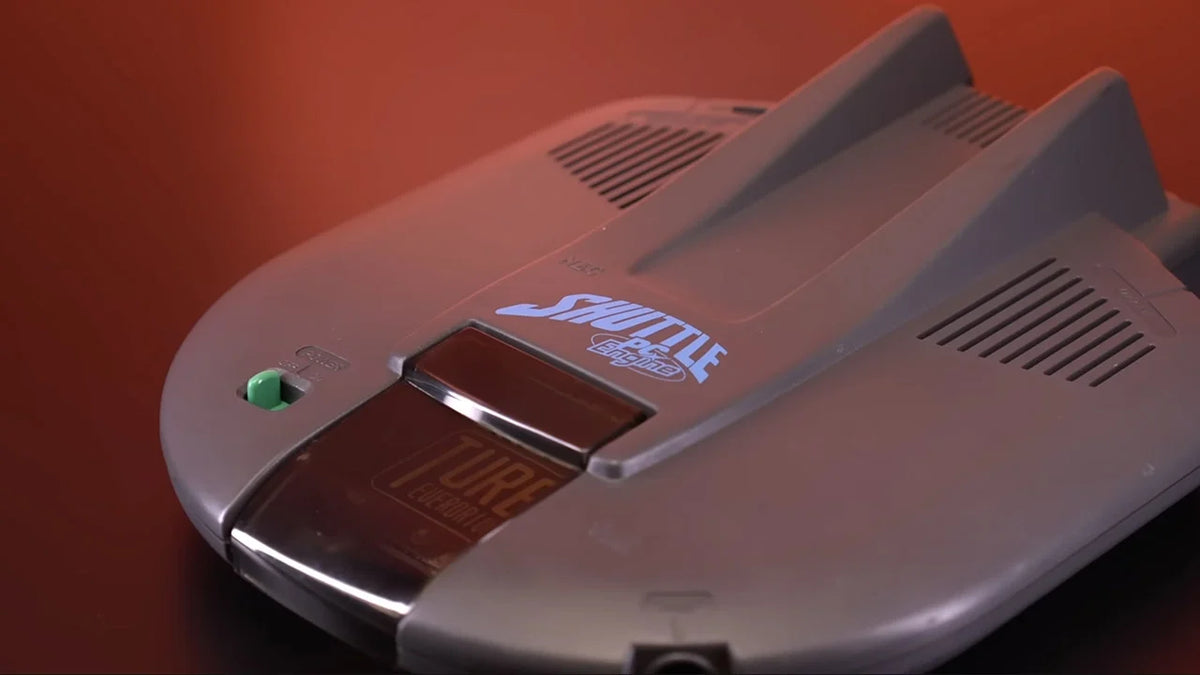
When NEC turns the PC Engine into a spaceship
By 1989, the PC Engine is already one of Japan’s most distinctive consoles. NEC and Hudson Soft have built an ecosystem around compact HuCards, unusual accessories and the increasingly important CD-ROM² format.
Then the PC Engine Shuttle arrives on November 22, 1989 and takes the family in a completely different direction.
Designed primarily for younger players, the Shuttle costs ¥18,800 and abandons the compact white box of the original PC Engine for something far more playful. Its wide body, curved lines and pointed front make the inspiration obvious. This console is supposed to look like a spaceship.
Within the wider Retro Gaming Collection, few systems capture late-1980s Japanese design quite as literally.
A cheaper PC Engine with a personality of its own
The Shuttle is not a more powerful PC Engine. Underneath its unusual shell, it continues to play the same standard HuCard library.
NEC’s goal is accessibility. The original PC Engine launches at ¥24,800 in 1987, while the Shuttle comes in significantly lower at ¥18,800. The new design helps differentiate it from the rest of the family while giving younger players a more approachable version of the system.
Even the controller changes. NEC includes the TurboPad II, redesigned to match the Shuttle’s more futuristic look rather than simply reusing the standard PC Engine controller.
 That attention to visual identity is one reason unusual Japanese systems continue to stand out in the Collectors Collection. Sometimes a console becomes memorable without changing the games at all.
The compromise hiding underneath
The lower price comes with one major sacrifice.
The original PC Engine is built around NEC and Hudson’s idea of expansion. Its rear expansion bus allows the system to connect to devices including the CD-ROM² setup, which becomes one of the most important parts of the PC Engine story.
The Shuttle removes that expansion connection.
As a result, it cannot use the CD-ROM² add-on. That is a significant limitation for a console family becoming increasingly associated with disc-based gaming, especially when the CD-ROM² system is already available by the time the Shuttle launches.
It can still use standard HuCards and supports a dedicated backup memory unit, but the Shuttle effectively chooses simplicity over the broader expandability that defines much of the PC Engine ecosystem.
That makes the surrounding world of PC Engine Accessories especially interesting. The family is full of modules, adapters and peripherals, yet one of its most visually adventurous consoles deliberately steps away from part of that philosophy.
Bad timing, great design
 Timing does not help the Shuttle either.
Only weeks after its November launch, NEC releases the CoreGrafx and SuperGrafx in Japan. The PC Engine family is suddenly expanding in several directions at once, with models aimed at different price points and audiences.
The CoreGrafx offers a more conventional evolution of the original PC Engine, while the Shuttle occupies a stranger position. It is cheaper and visually distinctive, but its lack of CD-ROM² compatibility limits how far owners can expand it.
That helps explain why it never becomes the defining version of the system.
But commercial importance and collector appeal are not always the same thing. Decades later, the exact qualities that make the Shuttle unusual in 1989 give it much of its personality.
Why the Shuttle deserves another look
The Shuttle represents an era when console makers are still comfortable taking real visual risks.
Its shape is immediately recognizable. Its controller belongs specifically to the machine. Its packaging continues the space-age theme, turning the whole product into something with a clear identity rather than simply another revision.
For collectors interested in original boxes, promotional design and related gaming Collectibles, that presentation matters. The Shuttle works particularly well as a complete object because the console, controller and packaging all speak the same design language.
We previously included it among Japan’s forgotten retro consoles worth rediscovering, and the argument still holds. Its limitations are part of the story, not a reason to ignore it.
Part of a much bigger PC Engine family
The Shuttle also makes more sense when viewed alongside everything else NEC does with the platform.
There is the original PC Engine, CoreGrafx, SuperGrafx, Duo systems and eventually the portable PC Engine GT. Each interprets the same ecosystem differently, from expansion-focused home systems to one of the era’s most ambitious color handhelds.
Few console families experiment with form quite this much.
The Shuttle may not be the most flexible PC Engine, but it might be the one that most visibly captures NEC’s willingness to try something different.

Legacy for players and collectors.
The PC Engine Shuttle never replaces the original PC Engine, and its missing CD-ROM² compatibility keeps it from becoming the most practical version of the system. But practicality is only part of what makes retro gaming interesting.
Its spaceship design, dedicated controller and unusual position within the PC Engine family give it an identity entirely its own. More than thirty years later, the Shuttle feels less like a budget compromise and more like a snapshot of an era when even an affordable console could afford to look completely different.
Share:
Nintendo Switch 2: Zelda celebrates 40 years in gold
RetroPixl Bundles: curated combinations, coming soon