
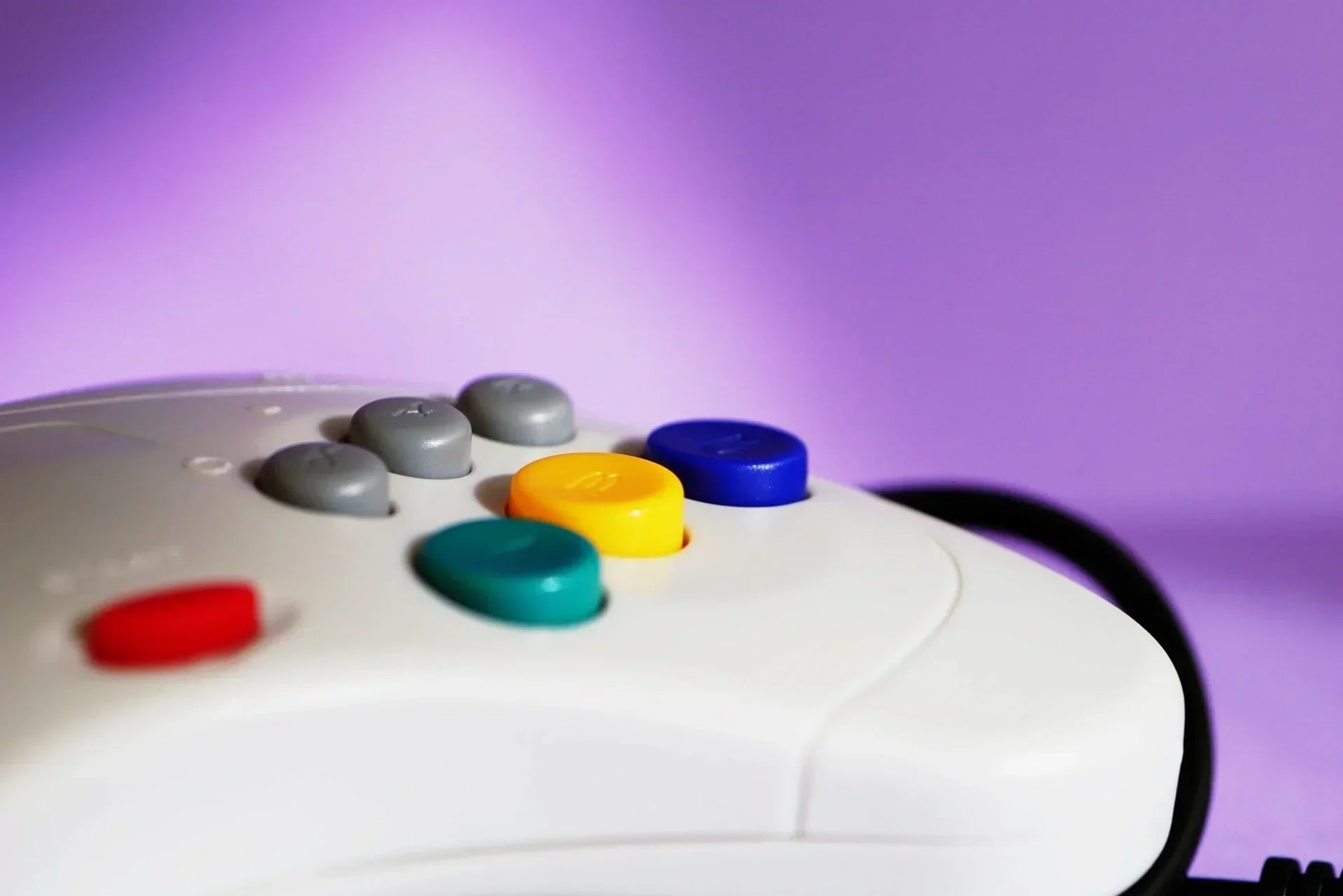
A bold step in design
When Sega unveiled the 3D Control Pad in 1996, it represented a turning point for console accessories. Built for NiGHTS into Dreams, the controller’s circular shape and analog precision felt years ahead of its time. While it arrived late in the Saturn’s life cycle, this accessory became a blueprint for the future of console input design, influencing everything from the Dreamcast to modern dual-stick controllers.
The evolution of comfort
Traditional Saturn pads were excellent for 2D fighters and shooters but lacked precision for the emerging 3D era. The 3D Controller’s rounded design fit naturally in hand, and its analog stick offered smooth motion in a way few accessories had achieved. The triggers, sculpted grips, and analog movement brought a level of immersion that paved the way for the dual-analog layouts still used today.

The 3D Controller pushed the Saturn into the modern era of analog precision.)
Engineering ambition
Internally, the controller was a marvel of engineering. The analog mechanism was based on magnetic resistance sensors rather than cheap potentiometers, giving it a smooth, durable response curve. Even decades later, collectors opening an brand new or mint or unit find remarkable build quality — far above competing accessories of the mid-1990s. Slight surface wear on complete-in-box units is common, yet most still function flawlessly.
Packaging and presentation
Japanese packaging for the 3D Controller reflected Sega’s design confidence. The box displayed a bold silver-on-blue color scheme with the Saturn logo in prominent katakana. Inside, molded inserts held the controller securely, while manuals featured clean illustrations explaining analog calibration — a rare detail for accessories at the time. Collectors value the original foam inserts, often showcased in displays alongside other pieces from the Accessories and Collectors Collection lines.

Sega Saturn 3D controller in its Japanese retail box
Influence on later consoles
The 3D Controller’s ergonomic ideas directly influenced Sega’s next generation: the Dreamcast pad. Its central analog stick, trigger placement, and curved grips evolved naturally from this prototype. Even modern controllers owe subtle cues to Sega’s experimentation. For collectors, this accessory marks the transition between 2D and 3D design philosophies, bridging two eras of Japanese hardware history celebrated in the Retro Gaming Collection and Home Systems sections.
Scarcity and collector demand
Unlike standard Saturn controllers, the 3D version was produced in smaller numbers, especially in Japan. Many units were sold exclusively as part of the NiGHTS into Dreams 3D Controller Set, making standalone boxes more elusive. Collectors now seek complete sets with the matching serial sticker and pristine manual. Listings in excellent condition regularly appear alongside high-end accessories and peripherals in the Collectors Collection and Retro Gaming pages.

Bundled editions have become collector favorites for their packaging and completeness.)
Display value
Beyond function, the controller has aesthetic charm. The circular silhouette and translucent buttons embody late-90s industrial design. Collectors often display it beside other Saturn peripherals — memory cartridges, multitaps, or modems — forming part of a larger narrative around Sega’s innovative yet short-lived era. That attention to design detail fits perfectly within RetroPixl’s Collectibles line, highlighting how accessories can transcend their original purpose to become design artifacts.
Legacy for collectors
Today, the Sega Saturn 3D Controller represents more than an input device — it captures a moment when console innovation moved toward the future. Every curve, sensor, and trigger reflects Sega’s engineering spirit. For collectors, owning one is a way to connect with a time when Japan led the world in hardware imagination.
Share:
Top Neo Geo AES Collector Units: The Crown Jewels of SNK’s Legacy
Game Boy Advance SP Value Today