
When Bandai tried something completely different
The mid-1990s are one of the most experimental periods in Japanese console history. Sony launches the PlayStation, Sega introduces the Saturn, and Nintendo prepares its move into 3D. In the middle of that technological race, Bandai takes a very different path.
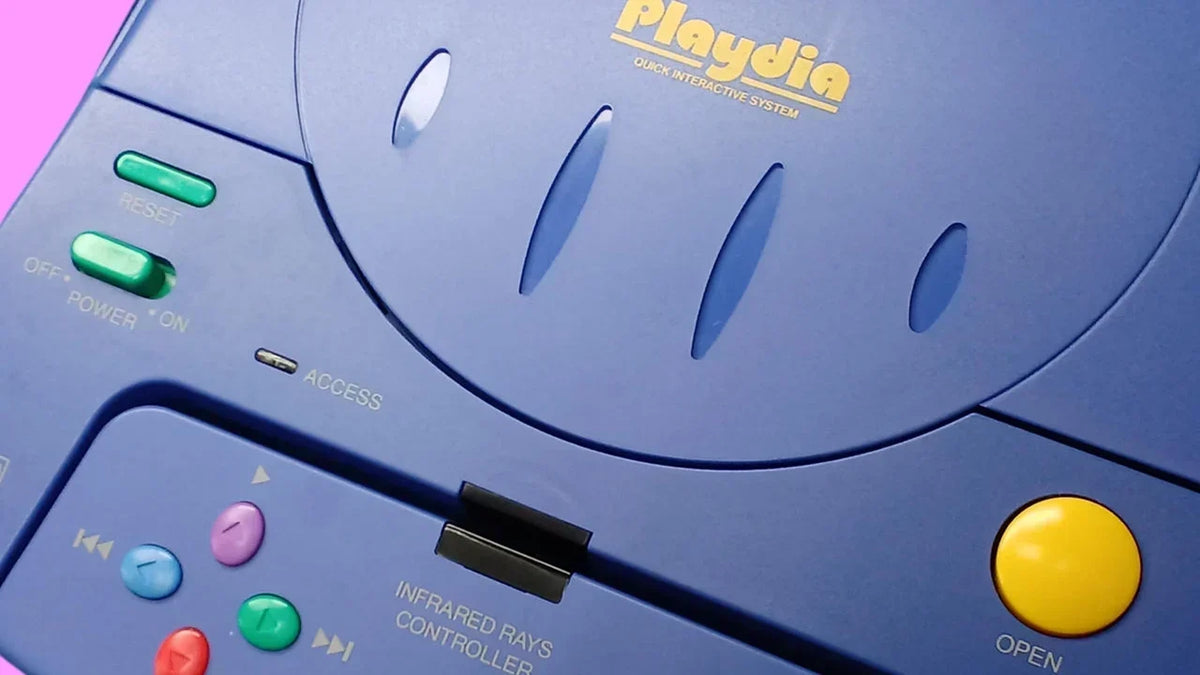
Released exclusively in Japan in 1994, the Bandai Playdia is a colorful CD-ROM console built around interactive entertainment rather than raw gaming power. With its bright blue shell, rounded shape, and unusual wireless infrared controller, it looks unlike almost anything else on the market.
Today, that difference is precisely what makes the Playdia such an interesting piece of retro gaming history.
A console built around Bandai's biggest characters

Bandai enters the console business with an advantage few hardware manufacturers possess: an extraordinary catalog of Japanese entertainment properties.
Rather than competing directly with the increasingly sophisticated games appearing on other Japanese consoles, the Playdia leans heavily into familiar characters and anime. Its library features properties such as Dragon Ball Z, Sailor Moon, Ultraman, Gundam, and Hello Kitty, making the machine feel almost like an extension of Bandai's toy and character business.
Many releases combine full-motion video, animation, quizzes, simple choices, and interactive sequences. By modern standards, the experience can feel closer to an interactive anime or multimedia CD-ROM than a conventional video game.
That unusual approach is also what makes the Playdia fascinating today. It captures a period when nobody is entirely certain what CD-based entertainment will eventually become.
That unmistakable blue design
There is little chance of mistaking a Playdia for another console.
The bright blue body, large circular CD lid, colorful buttons, and rounded proportions give it an almost toy-like personality. Bandai does not attempt the restrained black electronics aesthetic common to many machines of the period. The Playdia is designed to look approachable and fun.
Then there is the controller. Instead of connecting it to the console with a cable, Bandai uses infrared wireless technology, an unusually ambitious choice for 1994. The controller can also be stored neatly in a recessed area on top of the machine.

It is exactly the kind of quirky Japanese industrial design that makes unusual systems particularly interesting.
A very different kind of 32-bit-era machine
Calling the Playdia a direct competitor to the PlayStation or Saturn misses the point. It arrives during the same generation, but Bandai targets a younger audience and builds the machine around multimedia experiences rather than technical competition.
That decision ultimately limits its success as the market moves rapidly toward richer 3D worlds and increasingly sophisticated traditional games. The Playdia remains a Japan-only product and disappears after a relatively short commercial life.
Yet unsuccessful consoles often tell some of the most interesting stories in the Retro Gaming Collection. They preserve the ideas that did not become industry standards, and the Playdia represents one of the more unusual paths the CD-ROM era could have taken.

The Playdia as a collector console
Three decades later, the reasons to collect a Playdia have little to do with its commercial success. Its appeal comes from its rarity outside Japan, unmistakable design, unusual controller, short lifespan, and connection to some of Japan's most recognizable IPs.
Completeness matters too. The original box, documentation, power supply, AV cables, and infrared controller are an important part of the package. Finding original Accessories alongside a clean console helps preserve what makes the system such a distinctive time capsule.
The character-driven nature of its library also creates an interesting bridge between console collecting and Japanese Collectibles. For a Dragon Ball, Sailor Moon, Gundam, or Ultraman collector, the Playdia can be as interesting as a piece of franchise history as it is a gaming machine.

A strange experiment worth remembering
The Playdia never becomes the future Bandai may have imagined, but that makes it no less important. It represents a wonderfully experimental moment when Japanese companies are still exploring what a home multimedia machine can be.
For collectors drawn to unusual Japanese consoles, systems like the Playdia offer something the biggest commercial successes cannot: a glimpse into an alternate direction for the industry.

Legacy for players and collectors.
The Bandai Playdia is colorful, unconventional, and unmistakably a product of 1990s Japan. It may never challenge the giants of its generation, but its strange combination of anime, CD-ROM technology, wireless controls, and playful design gives it an identity entirely its own. Sometimes the consoles that lose the race become some of the most interesting ones to preserve.
Share:
Why Japanese retro gaming is back in focus
Sega Mega Modem: when Sega takes gaming online