
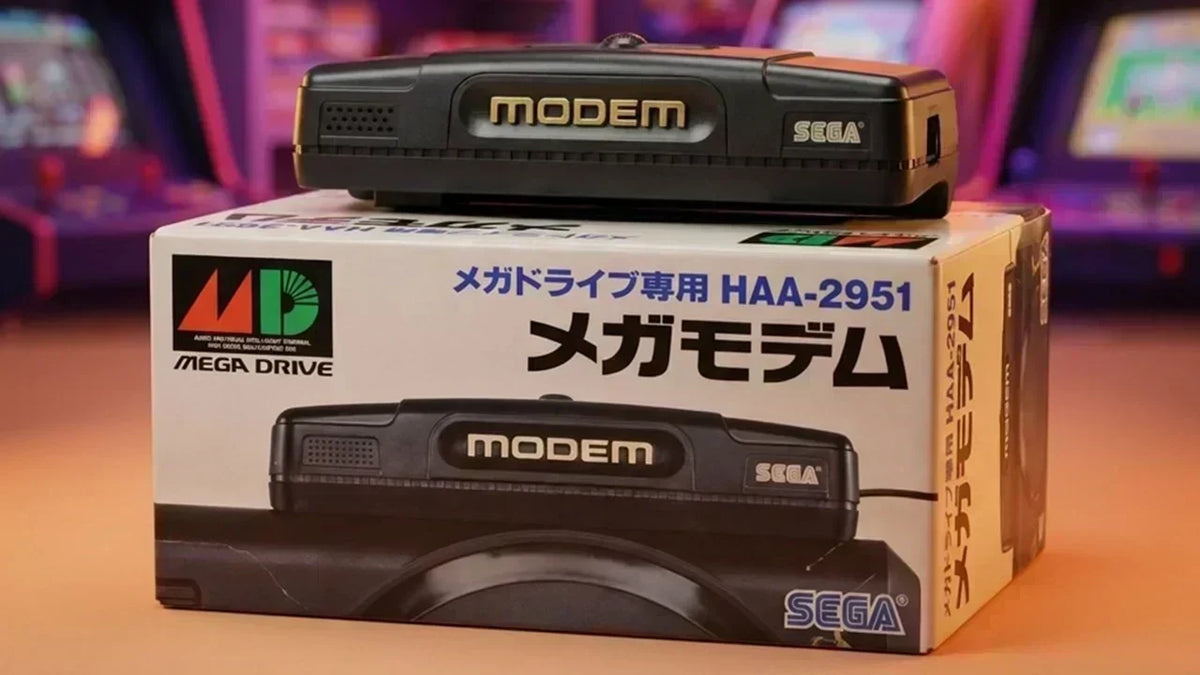
Online gaming before the internet becomes mainstream
Long before online gaming becomes an expected part of every console, Sega is already experimenting with connecting players from their living rooms.
Released in Japan on November 3, 1990, the Sega Mega Modem connects to the original Mega Drive and uses a telephone line to access Sega's network services. At a time when the idea of downloading content to a console sounds almost futuristic, Sega is already exploring it.
It is one of the more unusual Accessories of the 16-bit generation, but also an early glimpse of ideas Sega continues to pursue for years.

Turning the Mega Drive into a connected console
The compact Mega Modem attaches to the Mega Drive and communicates at 1,200 bps. Sega sells it either on its own or bundled with the Game Toshokan cartridge.
Game Toshokan, or Game Library, allows users to access and download small games over a telephone connection. Other compatible software explores communication between players, while Nikkan Sports Pro Baseball VAN delivers baseball information through the network.
By modern standards, the technology is extraordinarily limited. In 1990, connecting a Japanese console to a remote service from home is something very different.
More than online multiplayer
What makes the Mega Modem Accessory particularly interesting is that Sega does not view connectivity purely as a way for two people to play together.
The company experiments with downloadable games and information services, while related Mega Drive technology is even used for home banking through the Mega Anser system. The console is briefly becoming something broader than a machine designed only to play cartridges.
That experimentation gives the original Mega Drive another layer of significance within retro gaming history. Sega is testing concepts that feel remarkably familiar decades later: downloads, network services and subscription-based access.

An experiment that stays largely in Japan
The Mega Modem never becomes a defining part of the Mega Drive experience. Its Japanese audience remains limited, and the service exists during a period when connecting a console through a telephone line is still expensive and unfamiliar.
Sega considers bringing the concept to North America as Tele-Genesis, but the service never receives a commercial release there.
That makes the Japanese Mega Modem particularly interesting for collectors today. It represents a branch of Sega history that many Mega Drive and Genesis players outside Japan never experience at all.
From Mega Modem to Sega Channel and Dreamcast
The Mega Modem does not transform console gaming in 1990, but Sega does not abandon the idea of connected entertainment.
The company later experiments with Sega Channel on the Mega Drive and Genesis before making connectivity a much more important part of its strategy with the Saturn and, ultimately, the Dreamcast.
Seen in that wider timeline, the Mega Modem feels less like an isolated curiosity and more like the beginning of a recurring Sega obsession: finding ways to connect its consoles beyond the television sitting in front of them.

Why collectors remember the Mega Modem
For collectors, unusual peripherals can reveal as much about a console generation as the machines themselves. The Mega Modem captures Sega at its most experimental, willing to build something before the surrounding technology is truly ready for it.
Original packaging, the modem itself, cables, documentation and the Game Toshokan cartridge make complete examples especially interesting pieces of Japanese retro gaming accessory history. They also demonstrate why preserving original packaging and Collectibles around a system can help tell a much richer story than the console alone.
The Mega Modem may be small, but the idea behind it is anything but.
Legacy for players and collectors.
The Sega Mega Modem is a reminder that many ideas we associate with modern gaming begin much earlier than we remember. Downloads, connected services and console networking are already part of Sega's thinking in 1990. For players and collectors today, the accessory preserves a fascinating moment when Sega looks beyond the cartridge and starts imagining what a connected console could become.
Share:
Bandai Playdia: Japan’s forgotten console
Mini consoles: when retro gaming becomes miniature