
When collaboration reshapes a console generation
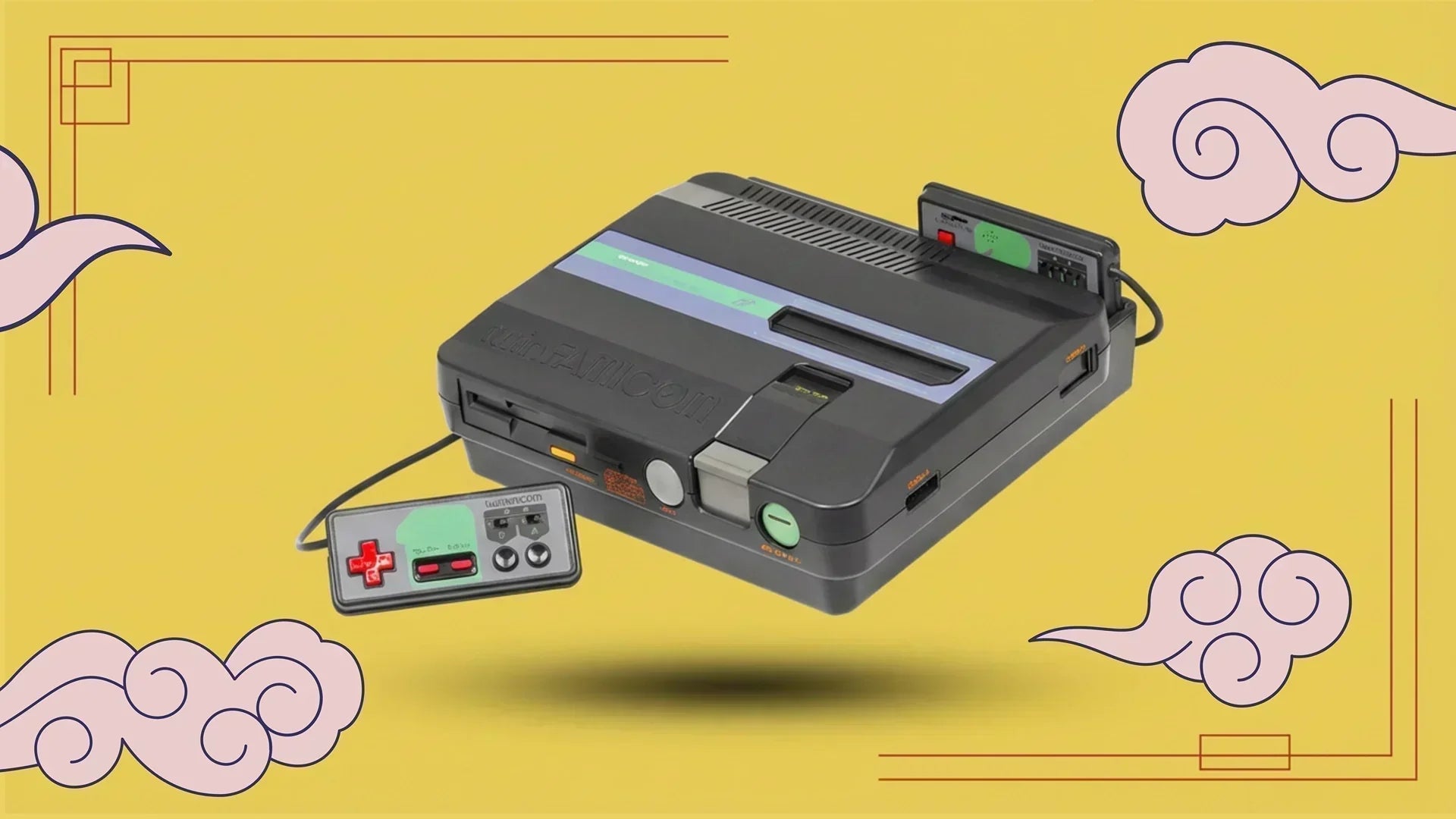
In the mid-1980s, Sharp and Nintendo deliver one of the most distinctive Japanese consoles of its era. The Sharp Twin Famicom integrates the original Famicom hardware and the Disk System into a single, cohesive unit. At a time when add-ons typically expand outward in cluttered stacks, this approach feels deliberate and refined. It reflects a design philosophy where engineering discipline and visual clarity move in tandem.
Integration before integration becomes standard
The defining feature of the Twin Famicom is consolidation. Cartridge functionality and disk-based play coexist within a unified shell, eliminating the need for external Disk System hardware. The disk drive sits seamlessly beneath the cartridge slot, preserving balance while improving usability.
This structural harmony places the Twin Famicom among the most forward-thinking entries in Japanese console history, a legacy reflected across foundational systems preserved within the Retro Gaming Collection.
Industrial design with Sharp identity
Where Nintendo’s original Famicom favors rounded forms and playful contrast, the Twin Famicom adopts sharper geometry and a more architectural silhouette. Its most recognized variants appear in bold Red and understated Black. Both emphasize symmetry, surface clarity, and visual confidence.
Integrated controller storage and refined button placement reinforce the sense that this is not merely a revision, but a reinterpretation.
Variants, revisions, and collector hierarchy
Over its production life, the Twin Famicom sees subtle internal revisions, including updates to the disk drive mechanism that improve reliability. These distinctions matter. Early units, later revisions, shell condition, and original packaging integrity all influence long-term desirability.
S-grade sealed examples are exceptionally scarce. A-grade units with vibrant shell coloration and intact box inserts anchor premium displays. Even well-preserved B-grade complete-in-box models remain highly respected when originality is maintained. Peripheral integrity, especially original controllers and disk drive condition, further strengthens collector appeal, particularly among those who value authentic period-correct accessories.

The AN-500R on the left and its black variant, AN-505BK, on the right.
Model distinctions and revisions
The Twin Famicom is released under two primary model codes. The AN-500R, finished in Red, represents the earlier production run and becomes the most visually recognizable version. Sharp later introduces the AN-505BK in Black, incorporating refinements to the internal Disk System drive aimed at improving mechanical reliability. While both models deliver identical functionality, collectors pay close attention to these distinctions. Model code, disk drive condition, shell integrity, and original packaging completeness all contribute to long-term desirability and subtle differences in collector hierarchy.

Iconic Twin Famicom controllers
Cultural weight beyond functionality
The Twin Famicom represents more than convenience. It captures a moment when hardware experimentation flourishes in Japan. Disk-based storytelling expands creative boundaries, while Sharp’s design sensibility reframes Nintendo’s platform through a more modern lens.
Today, collaboration consoles such as this occupy a distinct place among historically significant retro gaming, where engineering and aesthetic ambition intersect. While primarily a home system, its disciplined form language parallels the thoughtful refinement seen across Japanese Handhelds of the same era.
Legacy for players and collectors.
The Sharp Twin Famicom stands as a testament to collaborative innovation. It proves that elegance in console design emerges when technical integration aligns with visual restraint. Decades later, it remains one of the most compelling examples of how Japanese consoles blend engineering precision with enduring collector appeal.
Share:
Nintendo Game Boy Light: Japan’s luminous rarity
Remembering Hideki Sato: A Visionary Behind Sega’s Design Legacy